The first time I used AI for real work, I treated it like a search engine.
I typed in what I needed. I got back something that sounded polished. And I spent the next 20 minutes trying to figure out why it didn't quite fit what I was trying to do.
That was the beginning of a pattern I see everywhere now. People get access to one of the most powerful tools available, and they use it like they're asking a stranger for directions.
Quick Answer
A prompt library is a curated set of pre-written AI inputs designed for specific tasks. Instead of figuring out what to type every time, you pull from a library of proven prompts built for your industry and workflow. The result is faster, more consistent, and far more useful output than anything you'd get by winging it.
In this article, you'll learn:
- Why "just using AI" produces mediocre results
- What a prompt library actually is (and what it isn't)
- How the right prompt changes everything about what AI gives you
- Why real estate agents in particular benefit from a purpose-built prompt library
- How to get started without building one from scratch
The Problem with Using AI Off the Shelf
Most people use AI the same way. They open it up, type in a question or a rough idea of what they want, and see what comes back.
Sometimes it's great. More often, it's generic.
The output sounds fine. It's grammatically correct. It covers the basics. But it doesn't sound like you. It doesn't reflect your market, your clients, or the way you actually do business. So you spend time fixing it, rewriting it, or scrapping it and starting over.
That's not an AI problem. That's a prompt problem.
AI gives you back what you put in. Vague input produces vague output. And most people are putting in the AI equivalent of "write me something good."
The tool isn't broken. The approach is. OpenAI's own prompt engineering guidelines make this explicit: the quality of your output is directly tied to the quality of your instruction.
What a Prompt Library Is (And Why It Changes Everything)
A prompt library is exactly what it sounds like. It's a curated collection of pre-written inputs designed to get specific, useful output from AI for specific tasks.
Not generic questions. Not one-size-fits-all templates. Purpose-built prompts for the actual work you do every day.
Here's a simple way to think about it.
If you ask AI "help me write a follow-up email," you'll get something passable and forgettable.
If you ask AI "write a follow-up email for a buyer who said they need to think about it after touring a home in the $450,000 range, focusing on the scarcity of available inventory in that price range without being pushy," you'll get something you can actually use.
That second version is what a prompt library gives you. Not something you have to construct from scratch every time. A proven starting point that you pull up, plug in a few specifics, and go.
"Generic prompts produce generic results. The work happens in the prompt. Not after."Barton Eby
The difference between those two outputs isn't the AI. It's the instruction. And once you have a library of the right instructions, the whole experience changes.
Why Real Estate Agents Are Leaving Time on the Table
Real estate is relationship-driven, fast-moving, and document-heavy. There are follow-up emails to write, listing descriptions to craft, buyer objections to handle, and content to create. All on top of the actual job of selling and closing.
I've written about several of those areas in detail — why most agents follow up once and why that's costing them deals, how AI writes better listing descriptions than most agents write on their own, and how to write AI prompts that actually sound like you. All three are worth reading alongside this one.
Most agents know AI could help — Salesforce's State of Sales research shows AI adoption among sales professionals is accelerating year over year. But knowing AI exists and knowing how to get useful output from it are two different things.
So they type in something vague. They get something generic. They go back to writing things the old way. And AI becomes another tool they tried once and gave up on.
The problem isn't the tool. It's that they never had the right prompts for their specific work.
What Changes When You Have the Right Prompts
When a prompt is built for a specific situation, the output is immediately different.
Instead of spending 45 minutes drafting a listing description that sounds like every other listing in the MLS, you spend 5 minutes. Instead of staring at a blank screen trying to figure out how to respond to "I need to think about it," you have a prompt that handles exactly that objection, professionally and without pressure.
The difference isn't marginal. It's significant.
And when you have that kind of prompt ready for every stage. Prospecting. Listing presentations. Buyer conversations. Follow-up. Closing. You're not just saving time. You're operating at a different level.
Building a Prompt Library Takes Time. Here's the Shortcut.
You can build your own prompt library. I won't tell you otherwise.
But it takes time. You have to experiment with what works, refine what doesn't, and figure out which prompts actually produce usable output for your specific industry and workflow.
Most agents don't have time for that. And they shouldn't have to.
I want to be totally upfront with you. I'm not a real estate agent, and I've never sold houses professionally.
But I did have a conversation that changed my thinking.
A previous co-worker who used to work for me eventually left for personal reasons and got into real estate. We started talking about AI and how everyone seems to be using it these days. She said she'd tried using ChatGPT in her business but couldn't get anything useful out of it. Everything was generic. Nothing sounded like her. Nothing was specific enough to actually apply to a real client situation.
The more we talked, the clearer it became. She wasn't doing anything wrong. She just didn't have the right prompts for her specific work.
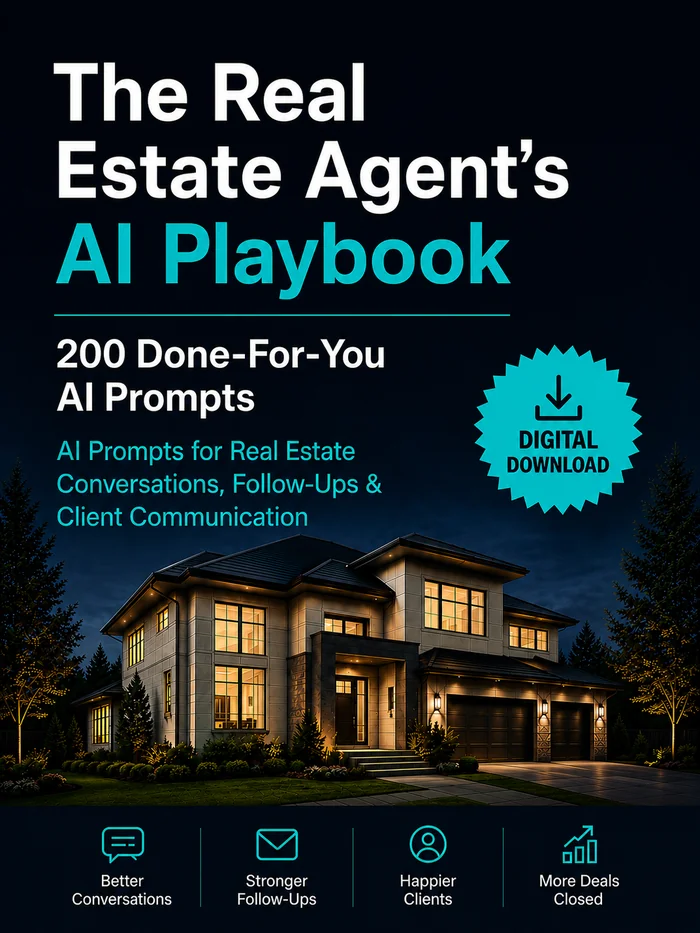
That conversation is what led me to build The Real Estate Agent's AI Playbook.
If you're a real estate agent, I've already done that work.
I built a library of 200 done-for-you AI prompts built specifically for real estate professionals. They cover every stage of the sales cycle. Prospecting, listing presentations, buyer conversations, objection handling, follow-up, and closing. Each one is designed to get you real, usable output without the back-and-forth of trying to figure out what to type.
Ready to stop winging it?
See what's inside The Real Estate Agent's AI Playbook and how it's built to work for your specific business. Take a look →
Key Takeaways
- AI is only as useful as the prompts you feed it. Vague input produces vague output.
- A prompt library eliminates the guesswork. Instead of constructing inputs from scratch every time, you pull from a set of proven, purpose-built prompts.
- Real estate agents have a specific set of daily tasks that AI can handle well. But only if the prompts are built for those tasks.
- Building your own library takes time. A done-for-you option gets you there faster.
Stop Winging It. Start Getting Real Results.
I built my prompt library because I got tired of spending time on AI output I couldn't use. The tool wasn't the problem. The approach was.
Once I had the right prompts, the output changed. Faster turnaround. More consistent quality. Less time fixing what AI gave me and more time actually using it.
If you're a real estate agent and you're still typing things into AI and hoping for the best, there's a better way.
You don't have to build it from scratch.